The Airlift Penny Project: How One Small Idea Took Hold
A penny is such a small thing.
Most of us barely notice one when we find it in a pocket, at the bottom of a purse, or tucked away in a drawer.
But a penny from 1948 or 1949, placed at the grave of someone who served during the Berlin Airlift, carries meaning and purpose. It becomes a "thank you, you are not forgotten."
And that is the heart of The Airlift Penny Project.
The idea began while I was planning a road trip along the California coast when I learned that a Berlin Airlift veteran was buried in a small-town cemetery along my route. I remember thinking, almost immediately, I want to stop and visit. Not because I had a big plan. Not because I knew exactly what I was doing. Just because it felt like the right thing to do.
As some of you know, I grew up in West Berlin. My life, the lives of countless others - and honestly, the world in which we live today - were shaped by what the Berlin Airlift accomplished. The men and women who made that mission possible did not just deliver coal, flour, medicine, and supplies. They helped keep a city alive. They gave people hope. They helped protect freedom at a moment when the future was anything but certain.
So, when I realized that one of those veterans was buried along my route, I wanted to stop, pay my respects, and say thank you.
And then, as often happens with ideas, one thought led to another: What if I did this whenever I travel?
What if, when I am on the road and learn that a Berlin Airlift veteran is buried nearby, I stop and pay my respects?
I had recently learned about the tradition of leaving coins on veterans’ graves. A coin left behind is small, but it carries meaning. It says someone came. Someone remembered. Someone was grateful.
And then the thought became more specific.
What if, for Berlin Airlift veterans, we left pennies from 1948 or 1949, the years of the Airlift? The years when planes flew day and night into Berlin. The years when pilots, mechanics, weather officers, nurses, air traffic controllers, drivers, cooks, unloaders, and so many others became part of one of the greatest humanitarian missions in history.
A penny is such a humble little thing. It is not grand. It is not expensive. But a 1948 or 1949 penny, placed with gratitude at the grave of someone connected to the Berlin Airlift, becomes something more. It becomes a thank you.
And that is where The Airlift Penny Project began.
Back to my California coast road trip ... I arrived at the cemetery in Olema, California, ready to find “my” Airlift veteran. I walked through the cemetery, looking carefully, searching row by row, reading names, hoping to find the grave I had come to visit. And I did not find it.
After a few phone calls with cemetery staff, I learned that he was not actually buried there after all. So, here I was, with this lovely little idea, a cemetery visit that did not go as planned, and no Airlift veteran to thank in Olema.

But by then, the idea had already taken hold. It had moved from “maybe I should do this” to “yes, this matters!”
I had also been in touch with the people at Luftbrücke Frankfurt-Berlin 1948-1949 e.V., who were preparing a ceremony at Steinkopf in memory of the three victims of the first crash of the Berlin Airlift. I shared the idea with them: leaving pennies in honor of Airlift veterans and victims.
They loved it. And not just in a polite “that’s nice” kind of way. They truly embraced it!
So, the first official placement of pennies for The Airlift Penny Project did not take place in the quiet California cemetery where I first thought it would begin. It happened at Steinkopf in Germany, at a memorial ceremony 28 years after the first crash of the Berlin Airlift on July 8, 1948.
The first crash.
The first official pennies.
The first people to say, yes, this is worth doing.
Sometimes the beginning you imagine is not the beginning you get. Sometimes it turns out even more meaningful.
Meanwhile, I am still in California, and I was not ready to give up on my own cemetery visit either. After Olema did not work out, I kept researching. That search led me to Valley Memorial Park in Novato, California, where I found two Berlin Airlift veterans. And this time, I found them.

I was able to stop.
I was able to stand there quietly.
I was able to say thank you.
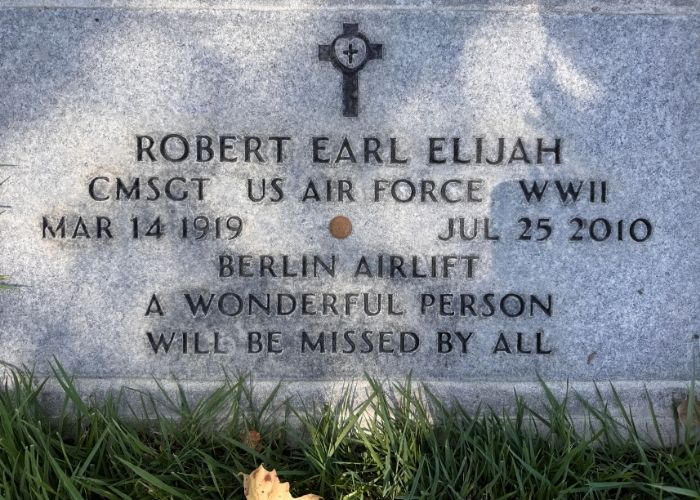
And I was able to leave a penny.
A very small thing, really. But also not small at all.
That is the heart of The Airlift Penny Project.
It is not complicated. It is not formal. It does not require a ceremony, although a ceremony can make it beautiful. It can be one person, one grave, one penny, one quiet thank you.
For me, it is a way to connect the history I care so deeply about with real people and real places. It is a way to remember that the Berlin Airlift was not only an operation, a date, or a chapter in a history book. It was made possible by individuals. People with names. Families. Stories. Jobs to do. Fear to overcome. Flights to complete. Reports to prepare. Planes to fix. Cargo to unload. Weather to watch. Lives to protect.
And every time we find one of them, we have a chance to say:
"You are not forgotten. Your service still matters. Thank you!"
My hope is that others will join The Airlift Penny Project, too.
If you know of a Berlin Airlift veteran buried near you, or if you discover one along your travels, consider stopping by. Bring a 1948 or 1949 penny if you can. Leave it respectfully. Take a photo if appropriate. Share the person’s name. Share a little of their story if you know it.
These are small gestures. But small gestures, done with love and gratitude, can travel far.
One penny at a time.
One veteran at a time.
One thank you at a time.
If you know of a Berlin Airlift veteran buried in your community, or if your family has photographs, letters, journals, documents, or memories connected to the Airlift, we would be honored to hear from you. Every story, no matter how small it may seem, helps preserve this remarkable chapter of history.
Please get in touch with us and help ensure these voices continue to inspire future generations.
