The First Pennies at Steinkopf: Remembering the Airlift’s First Fatal Crash
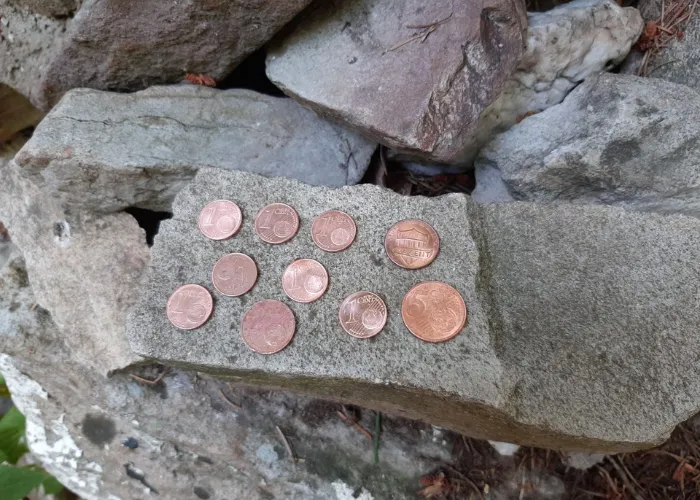
The first placement of pennies for The Airlift Penny Project happened in a forest on Steinkopf hill near Königstein in the Taunus. The location could not have been more fitting ...
Members of Luftbrücke Frankfurt-Berlin 1948-1949 e.V. organized the ceremony at the memorial marking the site where three men lost their lives during the opening days of the Berlin Airlift.
On the night of July 8, 1948, a Douglas C-47 took off from Wiesbaden-Erbenheim airfield carrying supplies for Berlin. The Soviet blockade had begun only two weeks earlier, and Allied aircraft were working to establish the lifeline that would eventually sustain the people of West Berlin for over a year.
Shortly after 11 p.m., the aircraft approached the 1870-foot-high (570-meter) Steinkopf hill. It struck the treetops near the summit and crashed into the forest.
All three men aboard were killed:
1st Lt. George B. Smith
1st Lt. Leland V. Williams
Karl Viktor Hagen
It was the first fatal accident of the Berlin Airlift, only twelve days after the operation began.
George B. Smith was born in Los Angeles in 1918. He had served during World War II and was later deployed as an Airlift pilot. He is buried at Mobile National Cemetery in Alabama.
Leland V. Williams was born in Tuscola, Texas, in 1920. He had been stationed at Erding Air Base, which served as an important maintenance and overhaul center during the Airlift. A residential community in Erding was later named Williamsville in his memory.
Karl Viktor Hagen was a German-born civilian employee working with the Currency Printing Committee under General Lucius Clay. He had played an important role in the secret transportation and distribution of the new Deutsche Mark, an operation known by the code name “Birddog.”
Hagen had left Germany in 1933. During World War II, he served with the Psychological Warfare Division, using his knowledge of Germany and the German language to encourage enemy soldiers to surrender. After the war, his work brought him back into the effort to rebuild a democratic Germany.
On July 8, he was traveling as a passenger aboard the C-47.
The Steinkopf memorial preserves the names of these three men and the history of the crash. The site has been cared for and expanded through the dedication of local organizations and individuals determined to keep the story visible.
When members of Luftbrücke Frankfurt-Berlin 1948-1949 e.V. placed the first Airlift pennies there, they added a new gesture of remembrance to that history.
The pennies do not replace the memorial. They do not attempt to measure the value of a life or the magnitude of a sacrifice. They simply say: Someone came. Someone remembered. Someone honored your sacrifice.

How fitting that the first placement of the Airlift Penny Project took place at the site of the first fatal crash of the Berlin Airlift.
The Airlift Penny Project began by remembering three people whose journey to Berlin ended in the forest at Steinkopf. Their lives remind us that the Airlift was not only an achievement measured in aircraft, flights, and tons of supplies.
It was a mission carried out by individuals.
Each had a name. Each had a family. Each had a story.
And each deserves to be remembered!
If you visit the grave of a Berlin Airlift veteran, consider taking a 1948 or 1949 penny with you as a simple gesture of gratitude. We'd love to see your tribute. Share a photo, tell us whose grave you visited, and help inspire others to remember these remarkable men and women, one penny, one story, and one thank you at a time.
