The Angel Cloud - Irene Bindel
The Angel Cloud - Irene Bindel
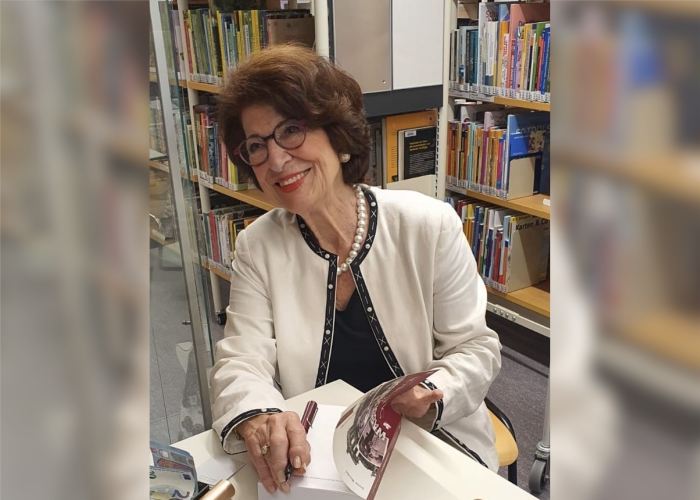
Irene Bindel
Airlift Child
Born 1938
How I Met Irene Bindel
I met Irene Bindel in May 2025 at an eyewitness event hosted by a Berlin secondary school. The school had organized the event to mark the 80th anniversary of the end of World War II. Irene was one of three eyewitnesses who had attended the school at the end of the war who were now sharing their memories with the audience.
Irene mentioned that she had written a book. After the event, I asked her about it – and that is how we first got to know each other. Soon afterward, we met and, during our conversation, she shared her memories of the Berlin Airlift. We immediately liked each other, later met again for dinner, and we have stayed in touch ever since.
Today, I’m happy to say we’ve become good friends.
The Angel Cloud
by Irene Bindel
It was 1948, shortly after my 10th birthday. I grew up in Zehlendorf, a quiet district of West Berlin that had escaped much of the worst destruction of the war.
But the silence in the skies above us did not mean we were spared from hunger.
That summer began with the currency reform. The Reichsmark was suddenly worthless, and everyone was given a small amount of new money, forty Deutsche Marks, just enough to survive for a few days. Berlin, already divided in spirit, was now also divided by currency.
When the Western Allies introduced the Deutsche Mark in their sectors, the Soviets responded swiftly and severely. Overnight, West Berlin was sealed off. No trains. No trucks. No barges. No coal. No food. The lights went out. The shops emptied. The streets grew quiet with uncertainty.
Our city was surrounded by the Soviets, an island without a bridge — until one appeared in the sky.
It started slowly, with a few planes flying in supplies. Then more. Then hundreds. Then thousands. By August, the “Rosinenbomber,” the “raisin bombers,” as we lovingly called them, were flying over Berlin every two minutes. At Tempelhof, they dropped tiny parachutes with candy for the children.
But not in Zehlendorf. We only heard about those little white handkerchiefs from others, never saw one ourselves. I can’t remember ever catchin g a single parachute.
But the Airlift reached us just the same, with powdered milk and dried vegetables, in flickering lights at night, and as a big surprise of a CARE package in mymother’s arms.
What I remember most are the dried carrots. To me, they were magic. I called them orangefarbene Schnipsel, orange-colored flakes. I would sneak a few and soak them in milk, proud of my little invention. Meine Speiseerfindung, culinary invention, I called it.
The milk was made from powder, of course — Trockenmilch (dry milk) — chalky, dry, bute air.
“Look, Mommy,” I woul oh, so precious! We had very little, and yet I loved blowing into the tin again and again, just to watch a little white cloud rise into thd say, “these are the clouds where the angels sit, the ones who bring us these gifts.”
My mother smiled, gently took the tin from my hands, and said, “If you keep blowing into it, the angels will get upset.” But then she would “work her magic,” as she liked to call it, turning the powder into milk. I would leap with joy, hopping across our cold apartment, delighted by that little miracle.
Our grandmother cooked on an old, tiled stove, though not often, and the pots were usually emdinpty. Coal was scarce and strictly rationed. Yet, I can still picture her stang in the kitchen, gently stirring something in the pan as the tiles gave off a faint, comforting glow.
We celebrated every bite. Even a single piece of chocolate felt like a birthday. And when a CARE package arrived? It was pure magic. “Simsalabim!” my mother would whisper before opening the box. I stood close beside her, my eyes wide and my heart pounding, anticipating what treasures might be hidden inside.
We rarely heard the planes in Zehlendorf. But we felt their presence. In the warmth of a bowl of soup. In the soft glow of a light bulb. In the simple joy of a can of corned beef. The Airlift lived in our home–not in the roar of airplane engines overhead, but in our daily gratitude.
At the time, I didn’t understand what was really happening. I didn’t know that people outside the city believed we might not survive the winter. I didn’t know that politics and power—and the future of Berlin—hung in the balance.
What I did know was this: the Americans and British were sending us gifts from the sky. Former enemies had now become bearers of hope. The French also played an important role in the Berlin Airlift
The Airlift didn’t just keep us alive. It gave us dignity, joy, and the promise of freedom.
Sometimes I wonder what became of those angels on the clouds, the ones who brought us powdered milk and hope ...
* Read more of Irene Bindel’s story in her book, Wassermilch und Spitzenwein – Ein Leben zwischen Schicksal und Zuversicht, ("Powdered Milk & Fine Wine – A Life Between Fate and Hope"), a 100-year family history in which she shares many more memories of her childhood in Berlin and the postwar years.
