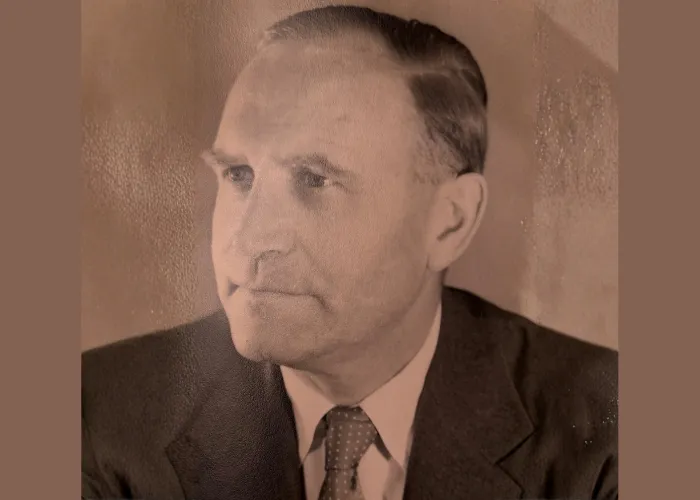
A Call at Three in the Morning – Kurt Lemke
A Call at Three in the Morning
Kurt Lemke
Airlift Logistics
Author's Note:
I first learned about Kurt Lemke in a very contemporary way: through a social media post.
As part of the Voices of the Airlift book project, I shared a call for stories in several Facebook groups, including the Weltfrauen-Gruppe. This group connects German women living all over the world. It is a space for exchange, support, shared memories, and perspectives shaped by migration, history, and lived experience.
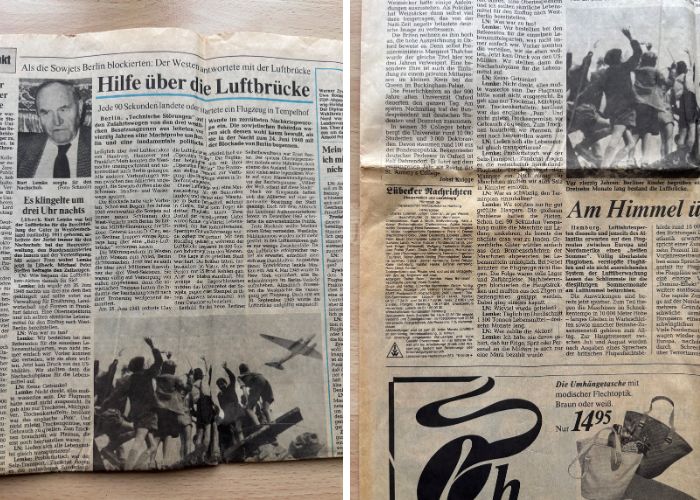
Among the many thoughtful responses I received was a message from Kurt Lemke’s daughter, Gesche Ventker. She wrote to tell me about her father and sent me a newspaper article that documented his role during the Berlin Airlift. Through her message and this article, a man stepped out of the background of history whose work had been essential, yet largely unseen.
A Call at Three in the Morning
According to the article „Hilfe über die Luftbrücke“, (Help through the Airlift) on June 23. 1988 in the paper Lübecker Nachrichten, Kurt Lemke’s personal involvement in the airlift began abruptly. In June 1948, as the Soviet blockade of Berlin took effect, Lemke was awakened at three o’clock in the morning. He was instructed to report immediately to Frankfurt and take on a task of immense responsibility: organizing the provision of food supplies for West Berlin.
Born in 1911 and trained as a jurist, Lemke was assigned responsibility for the civilian-side logistics of the airlift, specifically the procurement and coordination of food supplies in West Germany. While aircraft, flight crews, and air corridors have often dominated public memory of the airlift, Lemke’s work took place behind the scenes. Yet without it, no aircraft would have lifted off with meaningful cargo.
Supplying a City by Air
The article describes in detail the constraints under which Lemke and his colleagues worked. Everything transported had to be waterless, as weight and space were severely limited. Fresh food and beverages were impossible. Instead, West Berliners received dried eggs, milk powder, dried potatoes, dried vegetables, and the British potato product known as “Pom*.” Even the cookware required to prepare these foods had to be manufactured and supplied.
Lemke coordinated with multiple civilian departments and operated under growing pressure from U.S. military authorities. Distribution systems that had previously functioned independently were suddenly centralized and rigidly planned. Supply schedules had to align with a flight rhythm in which aircraft landed every ninety seconds.
Particularly challenging was the transport of salt, which initially arrived aboard British Sunderland flying boats landing on the Wannsee. When those flights ended, all salt had to be repackaged into canisters, adding another layer of logistical complexity.
Precision Under Pressure
Lemke’s role was not to fly planes, but to ensure that hangars were filled on time and that cargo was ready when aircraft arrived. Even slight delays had consequences. As the article notes, a delay of just ninety seconds could force a fully loaded aircraft to have to turn back, as the next plane was already cleared to land. Weather disruptions, especially fog, quickly led to congestion, overflowing storage areas, and damaged goods.
Despite these challenges, the results were staggering. For thirteen months, an average of 1,300 tons of food per day were delivered to Berlin. Lemke emphasized in the interview that he never heard of payments being made by German authorities for aircraft, fuel, or personnel. The airlift, from his perspective, was not a transaction, but a commitment.
Why Kurt Lemke’s Story Matters
Kurt Lemke was not a pilot, not a general, and not a political figure. Yet his work exemplifies a crucial truth about the Berlin Airlift: it succeeded because of thousands of people whose names rarely appear in history books.
His story represents the civilian German contribution to the airlift, the cooperation between former enemies, and the quiet professionalism that sustained an entire city through one of its most precarious moments. The article his daughter shared preserves his voice in a matter-of-fact tone, free of heroics, focused on responsibility, precision, and necessity.
Through this contribution, Kurt Lemke becomes what the Voices of the Airlift project seeks to honor: a reminder that history is not only made in cockpits and command centers, but also in offices, warehouses, and late-night phone calls that change the course of ordinary lives.
*Pom was a British potato product made from dried potato flakes or granules, used during the Berlin Airlift because it was shelf-stable, lightweight, and efficient to transport.
Primary source: Newspaper article “Hilfe über die Luftbrücke”, including an interview with Kurt Lemke, provided by his daughter, Gesche Ventker.
