I Was No Star - John Mazzella
Introduction
Sometimes one story leads to another.
I first learned about Chief Master Sergeant Emidie "John" Mazzella through a newspaper article celebrating his 100th birthday. The article mentioned that he had served as a weather observer during the Berlin Airlift, one of the many men whose work took place behind the scenes, helping pilots safely navigate the skies over Germany.
I immediately contacted the newspaper, asking if they might be willing to forward a message to him. I had no idea whether it would ever reach him.
It did.
A couple of days later, my phone rang. It was John's granddaughter. She sounded as excited as I was. "You won't believe the timing," she said. "Grandpa was just telling me he'd really like to talk about the Berlin Airlift. And then your email arrived.”
It felt as though the timing couldn't have been more perfect. We talked for a few minutes and agreed that I would fly to Colorado to interview him in person. Before my trip, I mailed each of them a copy of my book, Wings of Freedom.
A few days later, on a late night while I was in Berlin, John called. "My dear, dear lady," he began. "I got all choked up reading your book." Hearing those words from someone who had actually been part of the Berlin Airlift meant more to me than I can describe.
The day before I was scheduled to visit him, he called again. This time, he wanted to make sure I understood that I wasn't coming to interview one of the famous heroes of the Airlift. "I was no star during the Berlin Airlift," he told me. "I just worked the weather."
I smiled to myself. “John," I replied, "you don't have to be a star. You were there. You remember it. And I'd simply love to meet you."
When I arrived at his home the next morning, John had lost his hearing aids, making conversation more difficult than either of us had anticipated. Fortunately, I had brought my interview questions in writing. Whenever he couldn't quite hear me, he simply picked up the pages, read the next question, smiled, and answered in his own time.
What could have been an obstacle became a gift. The slower pace gave us time to reflect, laugh, and linger over memories that had been waiting more than seventy-five years to be shared.

By the time I left that afternoon, we had already made plans for the next visit.
John had insisted he was "no star." By the end of our time together, I knew that people like him were the reason the Berlin Airlift succeeded. Thousands of men and women worked behind the scenes, unseen by the world, yet without them the Airlift simply could not have succeeded.
I Was No Star
Emidie “John” Mazzella
U.S. Air Force Weather Service
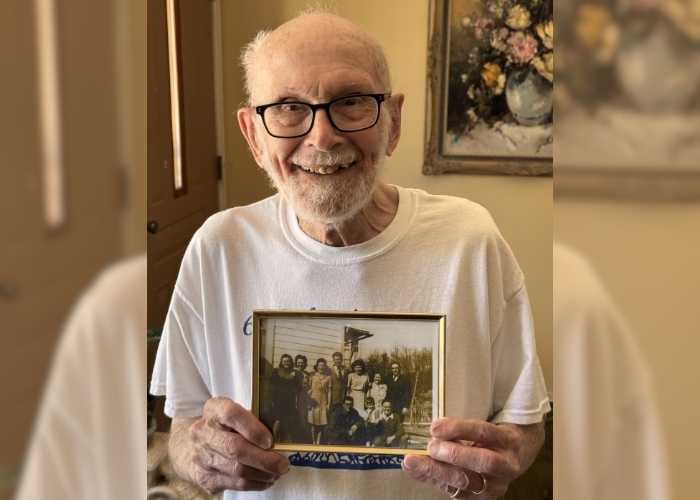
I told Bibi before she came to visit me, 'I was no star during the Berlin Airlift.' But she came anyway.
When people think of the Berlin Airlift, they usually picture the pilots flying through the air corridors into Berlin and landing every few minutes, day and night. Those men deserved every bit of recognition they received. I wasn't one of them.
I had already been stationed in Berlin in 1946 and 1947 before politics between the Soviet Union and the Western Allies changed everything. Because of the growing tensions, I left Berlin earlier than expected and was later assigned near Nuremberg before eventually ending up in Frankfurt. From there, I watched the Airlift unfold.
I was a Staff Sergeant in the U.S. Air Force Weather Service. During the Airlift, I worked in the I.G. Farben Building in Frankfurt. We didn't even take weather observations there. Our job was to plot weather maps, mark the observation stations, and prepare the forecasts for Rhein-Main Air Base and Berlin.
That's all I did.
But those forecasts became part of every mission. Every cold front, every layer of fog, every weather system moving across Germany had to be understood. Hundreds of aircraft relied on accurate forecasts, and the men flying those missions depended on us to provide the best information we could.
That was our contribution to the Airlift.

People sometimes ask whether I met the pilots. Not really. I saw them occasionally at Rhein-Main Air Base. They were usually coming or going. There wasn't much time for conversation. Those fellows worked incredibly hard. Some of them flew three trips to Berlin in a single day.
We always prayed for them. The flying wasn't easy. The three air corridors into Berlin were only twenty miles wide. Soviet fighters sometimes came up so close they were almost flying wingtip to wingtip with our aircraft before breaking away again. Everyone understood the risks. One pilot even had to bail out over Soviet territory. The Soviets held him for several weeks before releasing him.
General Lucius D. Clay visited our weather station once. Other senior officers stopped by from time to time, but most days were simply work. We concentrated on the forecasts. Weather mattered every single day. Good forecasts meant safer flights. Bad weather could affect the entire operation.
One thing I remember was hearing how they first loaded coal loosely into the airplanes. Coal dust got everywhere. Eventually they realized it made much more sense to bag it before loading it.
That's how the Airlift worked. Someone found a better way. Then everyone improved.
I also admired Gail Halvorsen very much. What he did meant far more than dropping candy. He lifted the morale of the children. He lifted the morale of Germany. He lifted the morale of America.
Soon people across the United States—and in other countries as well—were sending candy for him to drop. One man's simple act of kindness inspired thousands more. That is something worth remembering!
When the blockade finally ended in May 1949, we were thrilled. We had done it. We had kept Berlin alive.
More than two million Berliners had been kept from starvation because thousands of individuals, each doing their own job, worked together. Pilots flew the aircraft. Mechanics kept them flying. Load crews filled them with food and coal. And us weathermen watched the skies. Everyone had a part.
When people ask why the Berlin Airlift still matters, my answer is simple: It showed what people can accomplish when they choose compassion instead of conquest.
We helped keep millions of Germans from starving.
That's something future generations should never forget!
Before I Left
When our interview was over, John showed me around his home.
At 100 years old, he moved through the house with remarkable ease, walking up and down the stairs without hesitation. There was no walker, no cane. In the bathroom, he proudly showed me the small exercise bike he still uses. Then, almost matter-of-factly, he told me that he still goes dancing two or three times a week. As we talked, he pointed toward the coffee table.
There sat a simple urn.
"My wife," he said quietly. Then he smiled. "When I come home after dancing, my wife gets the last dance of the day."
For a moment, neither of us spoke.
It was one of those rare moments that stayed with me long after I left. I had come to Colorado Springs to meet a weather observer from the Berlin Airlift.
I left having met a man whose quiet humility was matched only by the depth of his love.
And it reminded me that history is ultimately about people.
