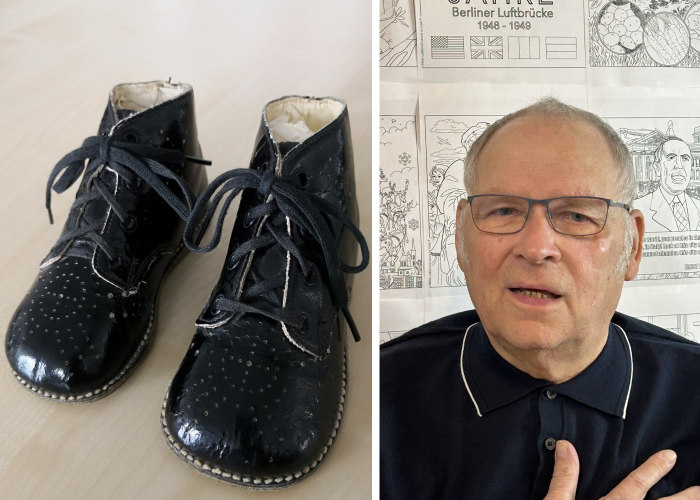
Baby Shoes and the Responsibility of Remembering - Norbert Kandzorra
Norbert Kandzorra
Born 1947
Airplane Mechanic (ret.)
I did not meet Norbert Kandzorra at an official commemoration or event, but through a simple email. I wrote to him because I was working on a book about the Berlin Airlift and asked whether I might use the logo of the Airlift Frankfurt–Berlin 1948-1949 Association for an illustration for the 75th anniversary of the Airlift. What began as a formal request quickly turned into a personal exchange.
Since then, a friendship has grown between us, based on a shared conviction: that it is important to tell the story of the Airlift and to pass it on. Norbert is someone who listens, connects people, and opens doors. He knows people, stories, and places, and he brings them together without placing himself at the center.
As an active member of the Luftbrücke Frankfurt–Berlin 1948–1949 e.V., Norbert is among those who do not see the Airlift as a closed chapter of the past, but as a living responsibility.
His story shows how memory continues to live on when people consciously preserve it. It begins with a pair of small baby shoes from a CARE package and leads to the question of why this history still matters today.
Baby Shoes and the Responsibility of Remembering
Norbert Kandzorra
I am Norbert Kandzorra. I was born in April 1947, shortly after the war. I did not consciously experience the Berlin Airlift. And yet it has accompanied me throughout my life.
The beginning of this connection is a pair of small, black baby shoes.
After the war, my father returned from captivity and worked in a refugee shelter. CARE packages from the United States also arrived there. They were distributed to families who had almost nothing. One of those packages contained my first shoes. My parents stuffed them with tissue paper so they would keep their shape. These shoes still exist today. They have accompanied me throughout my life and have become a silent testimony for me.
When I hold these shoes in my hands today, I do not think only of my own childhood. I think of all the children who depended on help after the war. Of families who would not have survived without that support. For me, these shoes are a symbol. They stand for care, for humanity, and for the connection to the Airlift.
Many years later, this personal connection became active engagement.
I am a member of the Airlift Frankfurt–Berlin 1948-1949 Association. The association is committed to preserving the history of the Airlift. Not as a dry collection of numbers, but as a human story.
Through the association, I had the opportunity to meet a man who, for me, embodies the human face of the Airlift like no other: Gail Halvorsen.
I remember our first meeting very clearly. What impressed me immediately was his presence. He had an honest smile, a warmth that cannot be learned. He remembered names, people, and encounters. When he entered the room, it felt brighter. Germany was his second home, and you could feel that.
Gail Halvorsen was not only a pilot. He was someone who acted on his own initiative. With two pieces of chewing gum in his pocket and the idea of giving children hope. From this small gesture, something great emerged, something that continues to resonate to this day!
When I meet eyewitnesses who tell me they once caught one of those small parachutes with candy, I see it in their eyes. That joy remained. It shows that the Airlift was more than logistics and organization. It had a heart.
That is why it is so important to me to carry this story forward.
Through the association, we speak with eyewitnesses, collect their memories, and share their stories. As long as these people are still with us, they carry something within them that no archive can replace. And even when there are no eyewitnesses left, the symbols remain. My shoes. The parachutes. The encounters.
We also remember those who lost their lives. Every year, we commemorate the dead of the Airlift. After a terrible war, they gave their lives to supply a city of 2.5 million people—without asking what it would cost.
I am convinced of this: the Airlift is not just history. It is a mindset. It shows what is possible when people take responsibility. When help matters more than power. When humanity stands above ideology. The democracy we live in today was built on this foundation.
That is why I continue to tell this story. That is why I bring my shoes to events. That is why I am committed to the association.
So that we do not forget what people are capable of when they stand up for one another.
