Tegel Airport – "Built with our Bare Hands" - Wolfgang Quurke
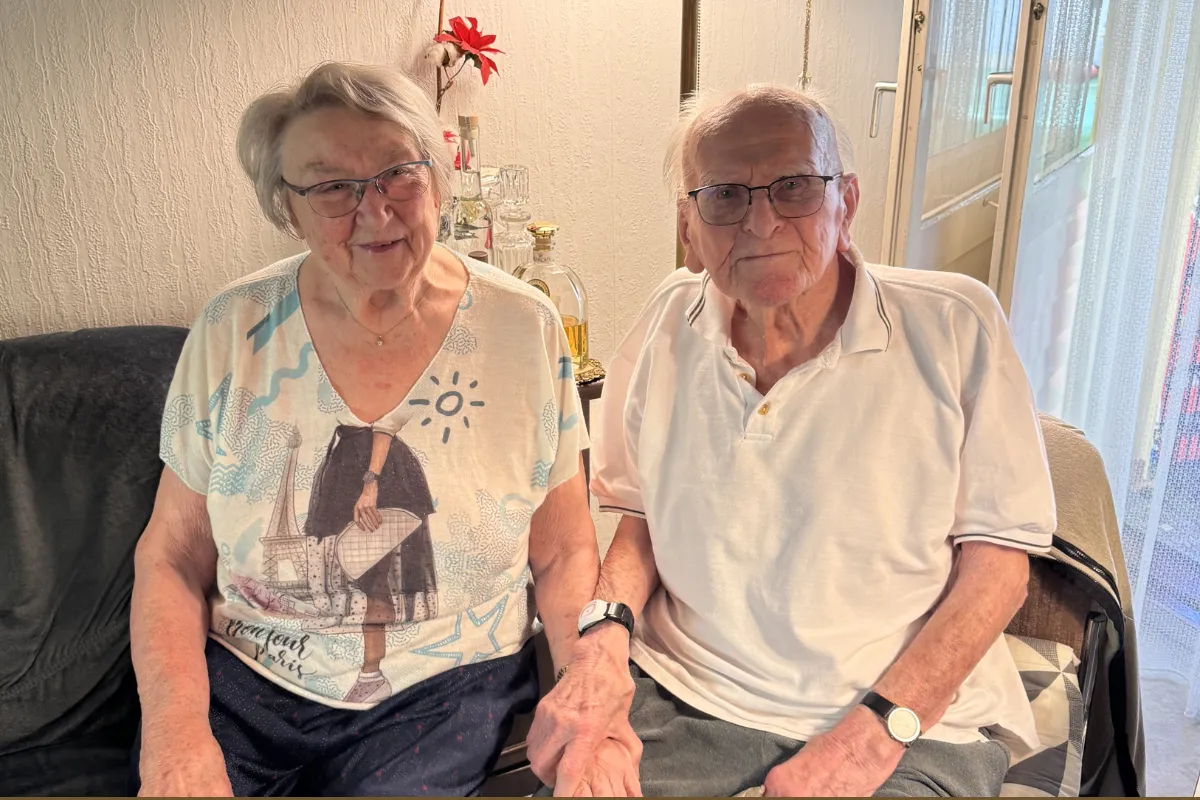
An Afternoon in Berlin-Reinickendorf with Wolfgang & Helga Quurke
We met through the Zeitzeugenbörse (Eyewitness Exchange). After our initial contact, Wolfgang and Helga Quurke invited me to their apartment in Reinickendorf, not far from Tegel, a place that plays a very special role in Wolfgang’s memories.
On a quiet afternoon, we sat together at the table, surrounded by family photographs, mementos, and the perspective of a life spanning many decades. What began as a conversation about the Berlin Airlift soon led to Tegel, to the days when thousands of Berliners built an airport there with their bare hands, an airport that would become a lifeline for the city.
Wolfgang and Helga spoke openly about their experiences: about hunger and cold, improvisation and solidarity, small gestures and major decisions. These were not rehearsed stories, but lived memories that unfolded naturally.
In their apartment, it became clear that the airlift is not a historical chapter for them, but a part of their own life story. Tegel is more than a place in these memories. It stands for perseverance, for rolling up one’s sleeves together, and for the knowledge that Berlin was not alone in one of its darkest hours.
Tegel Airport – Built with our Bare Hands
Wolfgang Quurke
Young Adult in Berlin during the Airlift
I was born in Berlin on May 17, 1929. When the airlift began, I was old enough to understand what was happening. And old enough to help.
The years after the war were marked by shortages. Hunger, cold, uncertainty. The first winters after 1945 were especially harsh. We had hardly any coal for heating, and often we could barely keep even one room warm. Everything revolved around survival, about getting through the day.
At times, we got warm meals at school. Occasionally, we received something called pemmican*, a calorie-rich food from America. It was not something one would choose voluntarily today, but back then it mattered. Calories were more important than taste. There were also C.A.R.E. packages: coffee, chocolate, condensed milk, dried potatoes. Things that are taken for granted today were something very special then. They meant hope.
When the blockade began, it quickly became clear that Berlin was cut off. The existing airports were not sufficient. Something new had to be built. And fast! Tegel.
I was among the Berliners who volunteered to help with the construction. Men and women alike. Altogether, there were tens of thousands of us. We were taken to the construction site in open trucks. There was shift work. Eight hours, sometimes more. The pay was low. But there was a hot meal. That alone was reason enough to come back every day.
It is worth noting that the warm meals were provided by the Americans — by the “Amis,” as they were called. In a short period of time, they had gone from wartime enemies to occupying soldiers, then to helpers, and finally to friends.
What we were very aware of was the difference between the occupying powers. The Americans, British, and French worked with us. They spoke with us, relied on us, trusted us. Soviet soldiers, on the other hand, were forbidden to have contact with the civilian population. This was strictly enforced. The separation was clearly noticeable in everyday life.
At first, much of the work was done with shovels. Moving earth, leveling uneven ground. Then machines arrived. Large machines I had never seen before. They cut through the ground and flattened the terrain. I still remember how impressed I was. What we could barely manage by hand, these machines accomplished in a short time.
Tegel was built in record time. About three months. Today it is hard to imagine. A runway built by civilians, in the middle of a destroyed city, under enormous time pressure.
When the first planes landed, it was a moment none of us ever forgot. Tegel was not simply an airport. It was a lifeline.
Alongside the work at the Tegel construction site, there were many small ways to get by. Survival depended on ingenuity, on solutions that are hard to imagine today. One of those came from a friend of mine from our street. He was a photographer and owned something extremely valuable: a Leica camera and a few rolls of film.
In the Soviet sector, people urgently needed passport photos. For identification cards, for papers, for anything that required proof of who you were. We drove over in the mornings and set up a simple photo corner wherever space could be found. A bench, two lamps, and a camera. Nothing more was needed.
Film was scarce. That is why we often photographed two people together in a single picture. The photo was later cut in half so that each person had their own passport photograph. Nothing was allowed to go to waste.
Payment was not made with money. Payment was made with whatever each person could give. An egg. A sandwich. Sometimes both. I carefully smuggled these items back across the sector border into West Berlin. The eggs were fragile. And valuable.
At home, they were shared. Each family received a portion. No one asked whether it was enough. It was enough because it was something.
My wife Helga also remembers this time very well. She was younger than I was, but daily life for her was shaped by shortages as well.
“You had to be inventive,” she says. “Nothing was thrown away. Everything was shared. And you were grateful for every little thing.”
She too remembers the cold. Apartments without proper heating. Improvised solutions. And how natural it was to support one another.
The airlift changed many things. Not only materially, but also in the relationship with former enemies. The Americans were first occupiers, then helpers, then friends. That happened surprisingly quickly. Trust developed within a short time. We worked together. German mechanics helped with American machines. We depended on one another.
The Russians, by contrast, kept their distance. Their soldiers were not allowed to make contact. This separation continued later during the Cold War.
When I look back today, I know this: without the airlift, Berlin would not have survived. Not as a free city. We would not have had the opportunity to shape our own lives. At the time, we did not speak in grand political terms. We did not think about ideologies. We thought about food, warmth, the next day. But that, exactly, was freedom.
Tegel has always remained a special place for me. Later, it became an airport that many people loved. Short distances. Clear layout. Human in scale. When it was closed, it made me sad. The airplanes belonged to Berlin. Their sound was part of the city.
I am a Berliner. Through and through. My parents were Berliners. And even though much has changed, this time remains a part of me. We did not ask whether it was worth it. We simply did what had to be done.
And Tegel still stands for exactly that for me today.
The airlift shaped us. It showed what is possible when people stand together and act, instead of just talking.
Wolfgang Quurke
Born 1929
Photographic Technician (retired)
Helga Quurke
Born 1940
Secretary (retired)
* Pemmican is a calorie-dense, nutrient-rich survival food made from rendered animal fat mixed with dried, powdered meat (such as bison, venison, or elk), sometimes combined with dried berries. Developed by Indigenous peoples of North America, it was later adopted by explorers and used as a long-lasting, high-energy food.
