A Parachute, A Shmoo, and Survival - Ruth Petersson
Ruth Petersson
Airlift Child
Born 1937, Berlin, Germany
Editors’ Note
Denise Halvorsen Williams, the daughter of Gail Halvorsen – the man many know as the “Candy Bomber” of the Berlin Airlift – made the introduction to Ruth Petersson, because Ruth’s story is inseparably linked to the small parachutes that once meant hope to so many children in Berlin.
Over a cup of coffee, Ruth’s shared her memories. They are not a retrospective analysis, but snapshots from a child’s point of view: fear, hunger, ingenuity – and a black Shmoo hanging from a parachute, which was far more than a toy ...
I am a Berlin child.
And like many children of my generation, I did not experience this great event as history, but as everyday life.
During the war, my mother, my sister, and I were evacuated to Thuringia. The Americans came from the south, through Italy and Austria, into Germany. To us, they were initially occupiers. We were the losers. I remember how they threw food they did not need into pits and covered it with earth. We saw it. But we thought: it must be that way.
Still, we were lucky. We were taken in by a family. The father treated us like his own children. I remember sitting in cellars when attacks were flown against Berlin. There was no radio. Only rumors.
At some point we heard: the Russians are standing at the gates of Berlin. In my child’s imagination, these were large wrought‑iron gates, and outside the Russians were pushing against them while we Berliners tried to hold them shut.
Then the Americans gave up Thuringia. It was assigned to the GDR, and Berlin was divided. Looking back, I have to say: thank God. For us, it was luck. Also, that my father returned from British captivity, unharmed.
And then came June 1948.
The blockade.
Suddenly all land and water routes to West Berlin were closed. All of them. They wanted to starve us, let us freeze. For us children, this was not a political strategy. It was hunger. Cold. Waiting.
We lived in Schöneberg, not far from Tempelhof Airport. And at some point it became known: parachutes would fall from the sky for the children.
My father was a clever man. He said, “We’ll do it this way. When I say ‘there, there,’ you run in that direction.”
We did not know what he was planning.
We were out and about, many people everywhere, many children. Then came his command: “There! There! There!”
We ran. Everyone ran. And while we were distracted, my father had already spotted the real parachute somewhere else and caught it.
And it was no ordinary parachute.
Something special was attached to it.
A black creature. A Shmoo.*
The Shmoo was soft, inflatable, a bit like a balloon. But the important thing was not the toy. Attached to the Shmoo was a voucher. For fat. Five or ten kilos – I no longer remember the exact amount.
Fat meant calories. Survival.
We had to redeem the voucher in Zehlendorf, on Clayallee, where the American embassy is today. How we got there, I no longer know. But we arrived. And it was not empty. Cameras everywhere. Reporters. The newsreel!
They wanted to show once again how a parachute falls from the sky.
My sister and I were given instructions again. Father went into the building, up to the attic, and threw the parachute out of the window. Down below, the cameras were rolling. My father was clever. He did not attach the real Shmoo with the voucher, but a dummy. The real one was safe.
The scene was filmed twice. I ran, almost stumbled, desperately wanting to be the first. Later the children at school said, “You were in the film!”
We ourselves never saw it. We had no money for the cinema. We only heard about it.
We redeemed the voucher. We received white fat, lard. No taste, no onions. But it had calories. And calories were everything. Each adult received a certain amount, children less. The fat helped us enormously. It was a real gain.
Then life went on. School. Everyday routine.
Many years later, everything resurfaced. A film. “Only the Sky Was Free.”
I watched it and suddenly thought: that’s me. My sister. Our story. You can see me in the original newsreel footage that the film uses.
I wrote to the production companies, searched for traces. That is how I came back into contact with Gail Halvorsen. I wrote to him, explained who I was. He sent me his biography. I have it in English and in German.
Since then, I attend commemorative events again and again. Tempelhof. May 12. I meet people from back then – mayors, eyewitnesses, veterans. We shake hands, even today, after many decades. Somehow, we belong together.
Memory does not come in order. It comes in fragments. Images. Smells. A black Shmoo on a parachute. White fat in tins. Cameras. Laughter.
Hunger.
We children did not know then that we were part of history. We just wanted to not be hungry all the time.
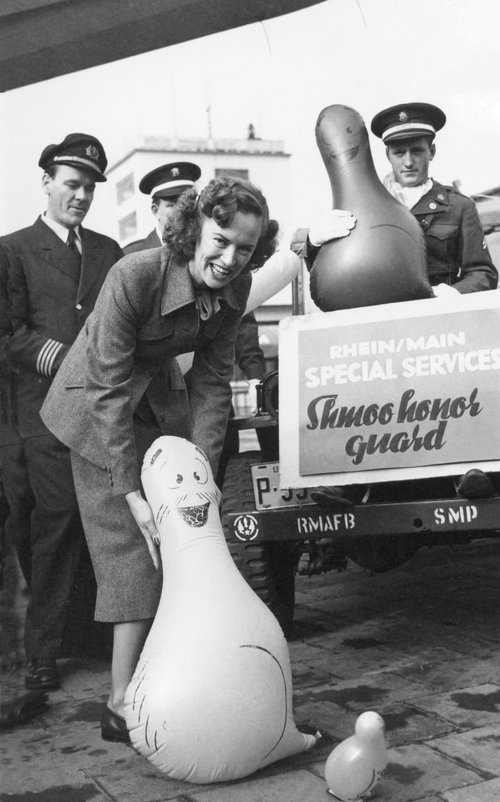
Public-relations display featuring Shmoo figures at Rhein-Main Air Base during the Berlin Airlift, ca. 1948–1949. U.S. Air Force photo.
*The Shmoo was a small, balloon-like figure inspired by a popular comic character created by Al Capp. During the Berlin Airlift, Shmoos were sometimes attached to parachutes dropped by U.S. pilots as part of the candy-drop missions. In some cases, they served as vouchers for food items, such as fat or lard, which were crucial sources of calories during the blockade. For Berlin’s children, the Shmoo was a toy; for their families, it often meant survival.
